The subscription total is the easy number to find. It’s rarely the biggest one.
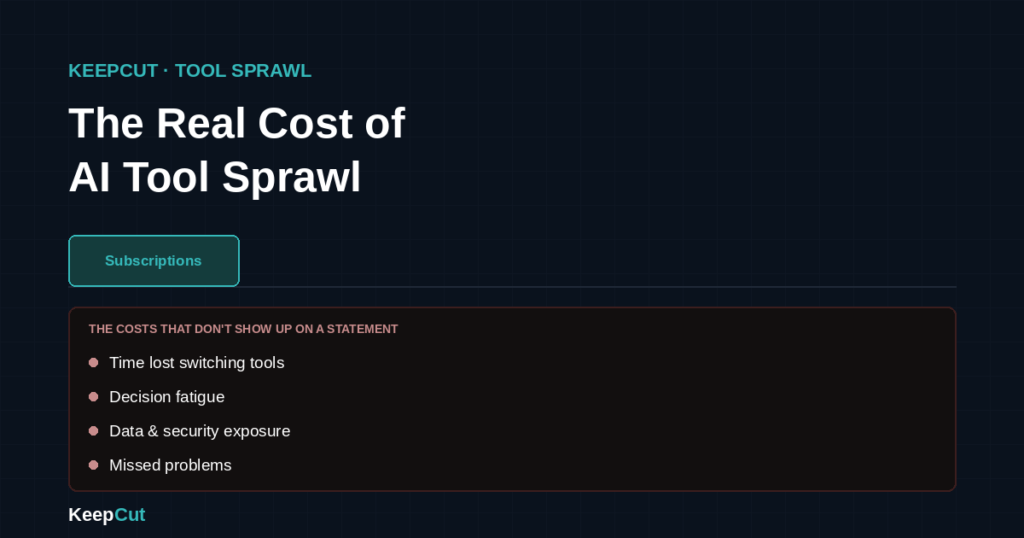
Ask most business owners what their AI and automation tools cost, and they’ll quote a monthly subscription total. That number is real, but it’s usually the smallest piece of the actual cost. Tool sprawl charges you in several currencies at once — and most of them never show up on a credit card statement.
The Obvious Cost: Subscriptions
This is the one everyone already tracks, at least loosely. Ten tools at $20–50/month each adds up to a few hundred dollars monthly — noticeable, but rarely the thing that actually motivates someone to do something about it. It’s also the easiest cost to fix, which is exactly why it gets talked about the most and why it’s not the whole story.
The Hidden Cost: Time
Every additional tool is another login, another interface, another place information can get stuck instead of flowing. Switching between six different tools to complete one workflow costs real minutes, several times a day, every day. That time never shows up as a line item anywhere — but multiplied across a year, it’s often worth more than the subscriptions themselves.
The Hidden Cost: Decision Fatigue
When three tools can technically do the same job, every new task comes with a tiny, invisible decision: which one do I use for this? That decision gets made dozens of times a week, and each instance is small — but the cumulative mental overhead is not. Teams with a cluttered stack make slower decisions on things that shouldn’t require any decision at all.
The Hidden Cost: Data Sprawl and Security Exposure
Every tool that touches customer data is another place that data can leak, get breached, or simply get forgotten about. A chatbot trial that nobody uses anymore doesn’t stop holding whatever conversation data it collected while it was active. Unused tools with old integrations and stale API keys are quiet security liabilities — not because anyone did anything wrong, but because nobody remembered they were still connected.
The Hidden Cost: Missed Problems
This is the one that matters most for AI agents specifically. A tool nobody is actively watching isn’t neutral — it’s actively degrading, silently. A chatbot that’s slowly drifting off-script doesn’t announce it. The cost of that isn’t a wasted subscription; it’s the customers it quietly mishandled while nobody was reading the transcripts.
Why the Subscription Number Isn’t the Real Number
None of this is an argument that cost doesn’t matter — it does. But if the only thing being measured is monthly spend, the actual damage from tool sprawl mostly stays invisible. The real cost is time lost switching contexts, decisions made worse by too many options, data sitting somewhere it shouldn’t be, and problems nobody caught because nobody was looking.
That’s the case for treating a stack audit as more than a cost-cutting exercise. Cutting the obviously unused subscription is the easy part. Finding the tool that’s quietly costing you customers, or the integration that’s quietly holding onto data it shouldn’t — that’s the part that actually requires someone to look.
Curious what your stack is really costing you — beyond the subscription total?