Most failing chatbots don’t announce themselves. They just quietly get worse — a little less accurate, a little more evasive — until a customer finally says something. Here’s what to watch for before that happens.
A chatbot rarely fails all at once. It fails gradually, one slightly-wrong answer at a time, until it’s confidently telling customers things that aren’t true — and nobody at the company notices, because nobody’s actually reading the conversations. The bot never sends an error message. It just quietly gets worse.
Here are five signs worth checking for, before a customer finds them for you.
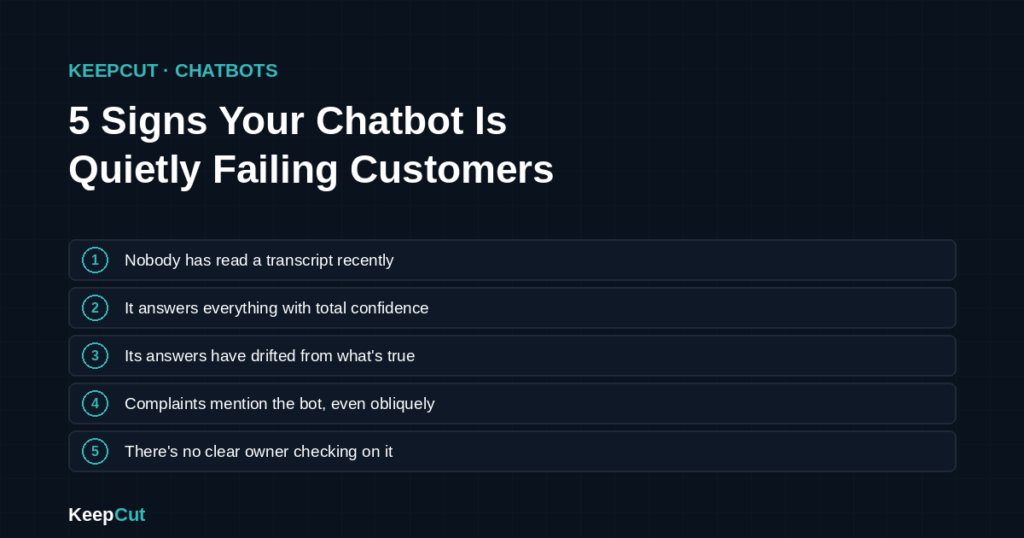
1. Nobody Has Actually Read a Transcript Recently
This is the single biggest predictor of an undetected problem. If the honest answer to “when did someone last read through 10 real conversations?” is “I’m not sure,” that’s the issue — not any specific technical failure. Dashboards showing volume and response time don’t tell you whether the answers were any good. Only reading the actual conversations does.
2. It Answers Everything With Total Confidence
A well-behaved AI agent should sometimes say “I’m not sure” or hand off to a human. If your chatbot has a confident, complete-sounding answer for literally everything — including questions it has no business answering — that’s not a feature, it’s a warning sign. Confidently wrong is worse than visibly uncertain, because confidently wrong doesn’t get double-checked.
3. Its Answers Have Drifted From What’s Actually True
Pricing changes. Policies update. Product details shift. A chatbot trained or configured months ago doesn’t automatically know any of that unless someone is actively keeping it current. If nobody has manually verified the bot’s answers against current reality in the last month or two, there’s a decent chance it’s telling customers something that used to be true.
4. Customer Complaints Mention the Bot, Even Obliquely
“I got confused talking to your chat thing” or “the assistant gave me the wrong information” are easy to write off as one-offs. They’re rarely one-offs. By the time a customer is annoyed enough to mention the bot by name in a complaint, it’s very likely already happened to other customers who just didn’t say anything.
5. There’s No Clear Owner Checking On It
This is the root cause behind the other four. AI agents get built, launched, and then handed no ongoing owner — everyone assumes someone else is keeping an eye on it. If you asked “whose job is it to review this bot’s performance monthly,” and there’s genuinely no clear answer, that’s the actual problem. Not the bot. The absence of anyone watching it.
What to Do About It
None of these require a full audit to check. A 30-minute spot-check — pulling 15–20 recent conversations and just reading them start to finish — will surface most of the obvious problems. It won’t be pleasant, but it’s fast, and it beats a customer finding the same problem publicly.
The harder part is doing that check regularly, not just once. That’s the actual gap most businesses have: not a lack of concern, but a lack of a repeatable process to catch drift before it becomes a pattern. That’s the specific problem ongoing monitoring is built to solve — not a one-time check, but a standing one.
Want someone else reading those transcripts every month, so you don’t have to?